By Marschant Probart – Certified Financial Planner
Updated 14 Aug 2026

For many South Africans, property has long been viewed as the default path to building wealth. Ask somebody what they would do with a large amount of money, and property will almost always feature near the top of the list. There is comfort in owning something tangible — you can improve it, finance it, rent it out and eventually pass it on.
There is also a widespread belief that property is inherently safer than shares. That belief is understandable. But once the numbers are compared consistently, the conclusion becomes less obvious.
Property can be an excellent investment. Shares can too. The challenge is that they are often measured differently: property investors frequently think in terms of house price growth plus rental income, while equity returns are usually evaluated as total return after dividends. To compare property vs shares fairly, both need to be measured on the same basis.
This article is not an argument against property. It is simply an attempt to compare the two more honestly.
What the Long-Term South African Investment Data Actually Shows
One reason property feels safer is because prices do not update every second. You do not open an app and watch your house lose 3% in a week. That lower visibility often creates the impression of lower risk.
However, South African residential property growth has historically been more moderate than many people assume. Statistics South Africa data suggests that national residential property price growth over recent multi-year periods has often been in the low-to-mid single digits annually.
That does not mean property underperforms. It means the return profile usually comes from several moving parts working together:
- Capital growth
- Rental income
- Leverage
- Long holding periods
Shares, meanwhile, represent ownership in productive businesses that generate earnings growth, dividends and reinvestment. Both create wealth — they simply do so differently.
Property vs Shares: A Fair Long-Term Return Comparison
Residential property and listed property are not the same thing. Residential property refers to privately owned housing, while listed property — represented by indices such as the ALPI — reflects listed property companies and REITs.
To compare property vs shares fairly, we should look at total return where possible.
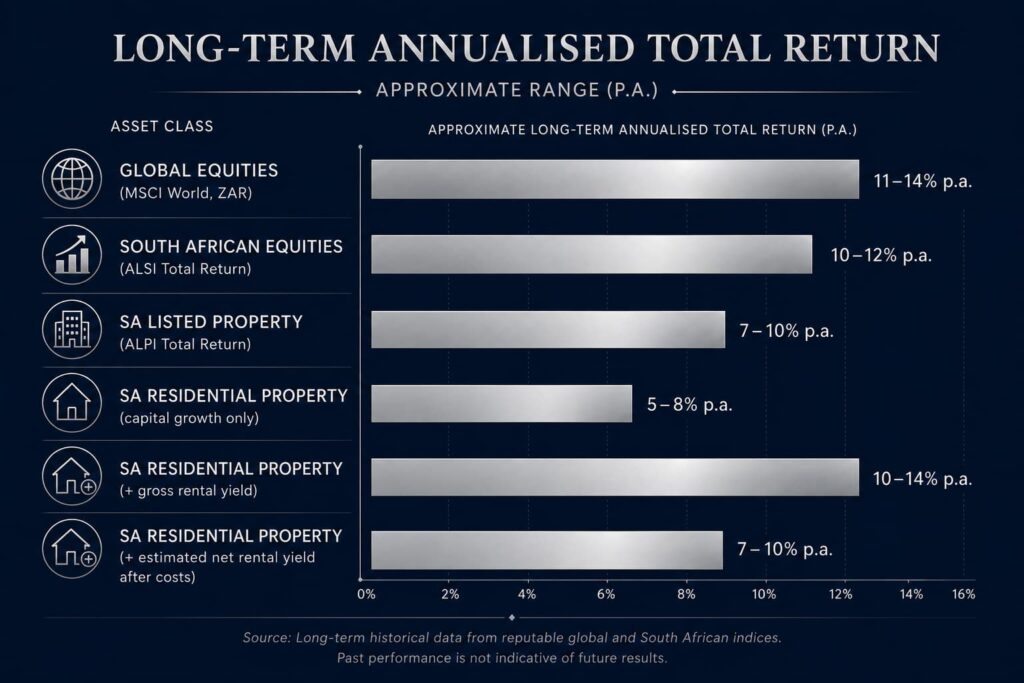
This is where the discussion becomes interesting. Once rental income is included, residential property actually compares much more favourably to equities. But once costs are also factored in, the comparison narrows again.
Why Gross Rental Yield Is Not the Same as Investor Return
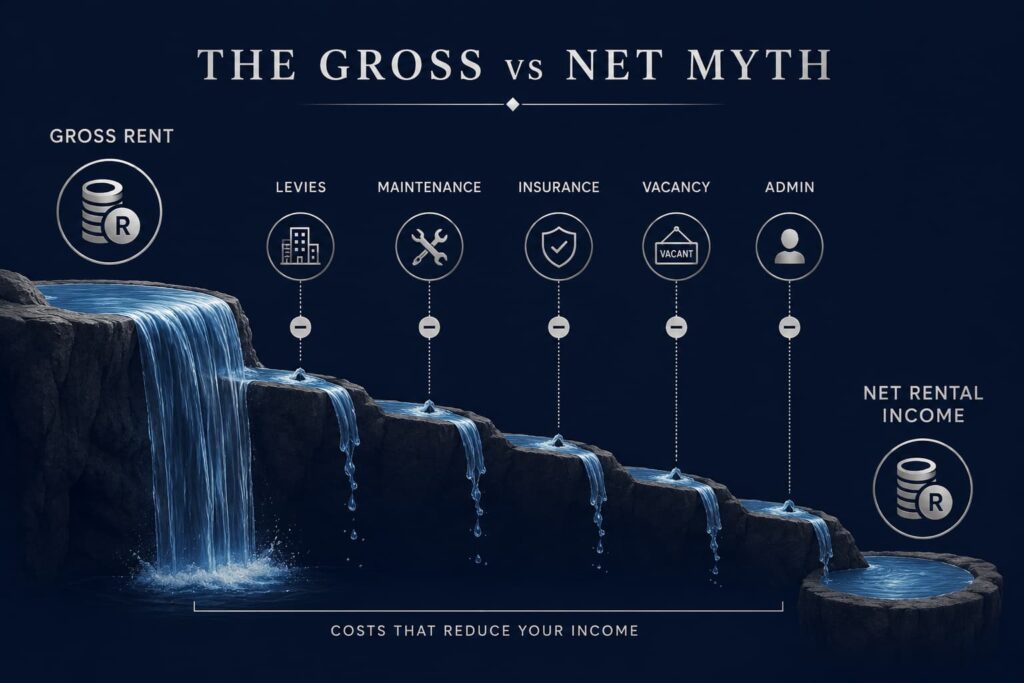
One of the biggest mistakes in property analysis is treating gross rental yield as investor return.
For example, assume an investor purchases a property for R1.5 million and receives R12,000 per month in rental income.
- Gross annual rent: R144,000
- Gross rental yield: 9.6%
That looks excellent. But investors do not receive gross yield. A more realistic annual example could look something like this:
- Gross rental income: R144,000
- Levies and rates: (R30,000)
- Maintenance allowance (approximately 1% of property value): (R15,000)
- Insurance: (R6,000)
- Vacancy allowance: (R6,000)
- Rental administration / management: (R11,500)
Approximate net rental income before tax and financing: R75,500
That reduces the effective rental yield from 9.6% gross to approximately 5.0% net.
Now include capital growth. Assume annual property appreciation of 6%:
- Capital growth: R90,000
Total economic return becomes:
- Net rental income: R75,500
- Capital growth: R90,000
- Combined: R166,000
Total return on property value: 11.1% p.a. before tax and financing
That is actually a very respectable result — and importantly, it puts property much closer to long-term equity returns than many investors realise.
How Financing Changes the Property vs Shares Picture
Now assume the investor only contributes a 10% deposit (R150,000) and finances the remaining R1.35 million at approximately 10.75% interest.
Annual interest costs alone could approach R145,000 in year one.
That means the investment may initially generate negative cash flow despite producing positive economic return. This is where property becomes highly sensitive to:
- Interest rates
- Rental escalation
- Occupancy
- Maintenance
- Holding period
Leverage can improve returns dramatically. It can also amplify mistakes.
Tax Implications: Property vs Shares in South Africa
Rental income is taxable. After allowable deductions, net rental income is included in taxable income and taxed at marginal rates. Capital Gains Tax may also apply on disposal.
Shares are taxed too. However, dividends and capital gains are often simpler administratively and allow greater flexibility in timing.
Tax should never determine an investment decision on its own, but it should always be included when comparing outcomes.
Diversification: Property Is Usually a Concentrated Investment

A R1.5 million rental property typically means exposure to:
- One suburb
- One property type
- One tenant profile
- One local market
A diversified investment portfolio, by contrast, may provide exposure to:
- Thousands of companies
- Dozens of countries
- Multiple sectors
- Multiple currencies
Neither approach is automatically better. But diversification is valuable.
Property Has Higher Friction Costs

Property carries meaningful transaction costs, which may include:
- Transfer duty
- Bond registration
- Legal fees
- Agent commission
- Compliance costs
These reduce investment efficiency before compounding even begins. Shares and ETFs generally allow easier scaling and lower transaction friction.
When Property Makes the Most Sense as an Investment
Despite everything above, there are situations where property can be one of the strongest investments available.
Primary Residence
Buying the home you live in often makes excellent sense. It creates stability, housing certainty and long-term flexibility. Return is only one part of the decision.
Strong Rental Opportunities
Property becomes attractive when:
- Net yields remain strong after costs
- Tenant demand is durable
- Vacancy risk is low
- Purchase prices are sensible
Sensible Gearing
Property’s biggest advantage may be leverage. Banks are often willing to finance residential property at attractive terms. Used carefully, gearing can materially improve outcomes. Used aggressively, it can become painful.
Final Thoughts: Property vs Shares Isn’t a Battle
Property versus shares should not be treated as a competition. Property can produce returns that rival equities. But property often requires:
- Leverage
- Concentration
- Administration
- Operational execution
- Patience
Shares may deliver similar outcomes with:
- Broader diversification
- Greater liquidity
- Easier scaling
- Less operational complexity
For many South Africans, the most sensible long-term investment approach may simply be:
- Own the home you live in.
- Build diversified investment portfolios.
- Add investment property selectively, only when the numbers genuinely justify it.
Property is not a bad investment. It is simply not automatically the best one.
Ready to Build a Diversified Investment Strategy?
Whether you’re weighing up your first rental property or want to review how property and shares fit into your long-term financial plan, our team at Affluence Capital can help you compare the numbers for your specific goals. Invest. Grow. Prosper.
Get in touch with Affluence Capital today to discuss a wealth strategy tailored to you.
Sources & References
South African Residential Property Data
- Statistics South Africa (Stats SA) — Residential Property Price Index and national residential market trends. statssa.gov.za
- Absa Homeowner Sentiment Index & House Price Reports — Historical residential property price growth and housing market analysis. propertyinsights.absa.co.za
- FNB Property Barometer — Long-term South African residential property and rental market commentary. fnb.co.za/property
South African Equity Market Returns 4. FTSE/JSE All Share Index (ALSI) — Long-term South African equity market performance and total return history. jse.co.za 5. Morningstar South Africa — Asset class performance, long-term return comparisons and fund analytics. morningstar.co.za
Global Equity Returns 6. MSCI World Index — Long-term developed market equity performance. msci.com 7. MSCI World Index Factsheets and Methodology — Index construction and historical return information. msci.com/indexes
South African Listed Property 8. FTSE/JSE All Property Index (ALPI) — Historical listed property market returns and index methodology. jse.co.za 9. SA REIT Association — South African listed property industry insights and data. sareit.com
Tax Treatment 10. South African Revenue Service (SARS) — Rental income taxation, allowable deductions and Capital Gains Tax guidance. sars.gov.za
Property Financing & Lending Environment 11. South African Reserve Bank (SARB) — Interest rate history and monetary policy data. resbank.co.za 12. BetterBond Home Loan Market Reports — Residential lending trends and mortgage market data. betterbond.co.za