By Marschant Probart – Certified Financial Planner
Updated 8 Dec 2025
Offshore investing is one of the most effective ways for South Africans to grow and protect long-term wealth. In today’s global economy, investing internationally is no longer optional — it’s a strategic tool for diversification, rand protection, and accessing world-class investment opportunities unavailable locally.
This guide explains why South Africans should invest offshore, the best ways to externalise funds, how tax and CGT work, and how to choose the right offshore investment structure for your financial goals.
Why Offshore Investing Matters for South Africans
1. True Diversification Across Markets and Currencies
For South Africans, diversification is vital. Offshore exposure allows you to:
- Reduce reliance on a single country’s economy, politics, and market cycles
- Access global sectors missing from the JSE (technology, biotech, consumer giants, AI)
- Protect wealth against rand weakness — historically ±5% depreciation per year against the USD
- Improve risk-adjusted returns through global equities, bonds, and alternatives
2. South Africa Is Less Than 1% of Global Markets
South Africa makes up under 1% of global equity markets, meaning 99% of investment opportunity sits offshore.
10-Year Performance in ZAR (to 31 Oct 2025):
- MSCI World: +264.899%
- Capped SWIX: +101.967%
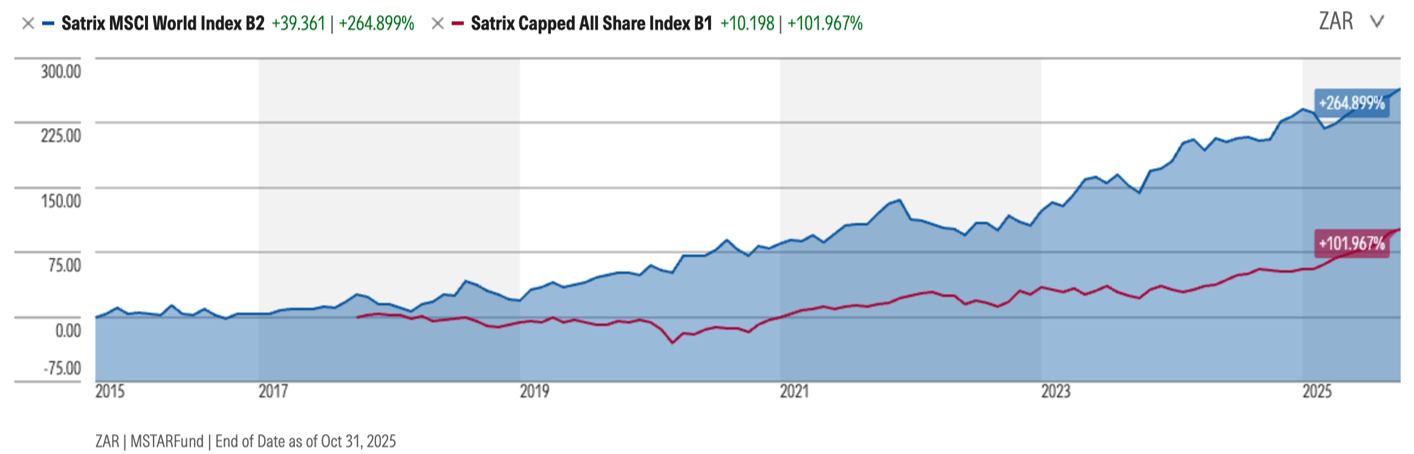
Over this 10 year period till 31 Oct 2025, in Rands, the offshore investment has outperformed the local only investment by more than 2.5x. That is, +264.899% MSCI vs +101.967% of the Capped Swix.
This shows how important it is to have exposure to non-SA companies when it comes to your wealth.
How South Africans Can Invest Offshore (Two Main Methods)
South Africans can grow wealth globally through two channels:
1. Externalising Rands (SDA & FIA)
Best for investing directly into foreign currency.
Single Discretionary Allowance (SDA)
- Up to R1 million per person, per calendar year
- No TCS pin required
- Fast and simple way to start building offshore assets
Foreign Investment Allowance (FIA)
- Up to R10 million per person, per calendar year
- Requires a TCS pin and documentation
- Ideal for larger transfers, offshore property, and wealth migration planning
Couples can combine allowances to externalise more efficiently.
2. Rand-Denominated Offshore Exposure (Asset Swap & Feeder Funds)
Best for convenience and SA companies/trusts.
Asset Swap
Your investment platform uses its corporate offshore allowance to buy global assets for you.
- Your account remains rand-based
- You stay a SA tax resident
- Does not use your personal SDA/FIA
- Popular for companies and trusts wanting offshore exposure
Feeder Funds
Local unit trusts investing directly into offshore master funds.
- Invest in rands
- Manager handles currency conversion
- Good for debit orders and long-term global diversification
Use Case Summary
- Feeder Funds: Best for ease, debit orders, simplicity
- Asset Swap: Best for companies, trusts, or exceeding offshore allowances
Capital Gains Tax (CGT): Offshore vs Asset Swap
CGT works differently based on how you invest.
CGT Example: Direct Offshore Investment
Here, the base cost and proceeds are in foreign currency, and then the gain is converted into Rands.
- Buy 100 shares of Company A @ $400 per share.
- The share price increases to $700 over 5 years, and you sell the shares. On disposal, the rand at R17.20 to the US Dollar.
Capital Gain = Proceeds – Base Cost
Proceeds = $700 × 100 shares = $ 70,000
Base Cost = $400 × 100 share = $40,000
Capital Gain in Rands = ($ 70,000 – $ 40,000) × 17.20 = R 516,000
- For individuals, 40% of this is taxable at your marginal tax rate
Direct offshore investments are great for if you want to be able to access the funds directly in a foreign country. This can be withdrawn directly to an offshore bank account in your name.
CGT Example: Asset Swap
Here, the base cost and proceeds are in local currency, thereby capturing the currency movement as well.
- Buy 100 shares of Company A @ $400 per share, at 16.50 to the US Dollar.
- The share price increases to $700 over 5 years, and thereafter you sell at R17.20 to the US Dollar.
Capital Gain = Proceeds – Base Cost
Proceeds in Rands = $700 × 100 shares × 17.20 = R 1,204,000.00
Base Cost in Rands = $400 × 100 shares × 16.50 = R 660,000
Capital Gain in Rands = R 1,204,000.00 – R 660,000 = R 544,000
Notice the capital gain in this example is larger than in example 1 as you have additional gain from the Rand depreciation.
The inclusion rate and tax bracket determine your effective CGT. Portfolio structure (trusts, endowments) can change rates and timing.
Bottom line:
- Direct offshore = optimal for accessing or spending money abroad.
- Asset swap/feeder = efficient for local admin, recurring investing, and simplicity. As well as SA companies and Trusts.
Offshore Estate Planning for South Africans
Investing offshore introduces additional estate and succession considerations.
Separate Offshore Wills
If you own assets in the UK, US, EU, or other foreign jurisdictions, a dedicated offshore will can prevent delays and reduce probate issues.

Offshore Endowment Wrappers
These structures can:
- Allow beneficiary nominations (reducing executor fees)
- Potentially avoid foreign probate
- Offer simplified tax treatment
- Streamline multi-country succession planning
Final Thoughts: A Global Portfolio Builds Long-Term Resilience
Offshore investing is not about emigrating.
It’s about building a globally diversified, multi-currency portfolio that delivers long-term stability, growth, and rand protection.
With the right strategy, South Africans can:
✓ Protect purchasing power
✓ Reduce country-specific risk
✓ Access international markets
✓ Benefit from global compounding

Ready to Build Your Offshore Strategy?
Book a consultation and we’ll design a personalised global investment plan aligned with your:
- Allowances
- Tax profile
- Estate planning needs
- Long-term financial goals
All without unnecessary complexity.