By Marschant Probart – Certified Financial Planner
Updated 15 Aug 2025
Discover why time in the market beats timing the market. Learn how patience, discipline, and long-term investing strategies build lasting wealth.
Let’s face it – investing can feel daunting. Markets can be volatile, and that volatility often plays havoc with our emotions and financial decision-making. The COVID-19 outbreak was a stark reminder of both our human fragility and how quickly fear can influence investment strategies.
During the early months of 2020, many investors were understandably anxious. The S&P 500 Index dropped about 34% from its February peak to its March trough – the fastest fall into bear market territory in history, taking just 23 trading days. The MSCI World Index and the JSE All Share Index (ALSI) both experienced similar drawdowns of around 33% over the same period.
To put that in perspective: if you bought at the top and endured that 33% drop, you’d need a return of roughly 50% just to break even.
Why Investors Panic
Behavioural finance teaches us about Prospect Theory, which shows that losses hurt more than gains feel good. This emotional bias can push investors to take drastic actions – like selling to cash to “protect” capital or attempting to time the market to catch swings.
The reality? Market timing is incredibly difficult, and getting it wrong can cost far more than most people imagine.

The Numbers Don’t Lie
A JP Morgan study looking at a 20-year period ending June 2025 found that seven of the 10 best market days occurred within just two weeks of the worst days. Missing those 10 best days (because you were sitting in cash) would have left you with less than half the returns you’d have earned by simply staying invested.
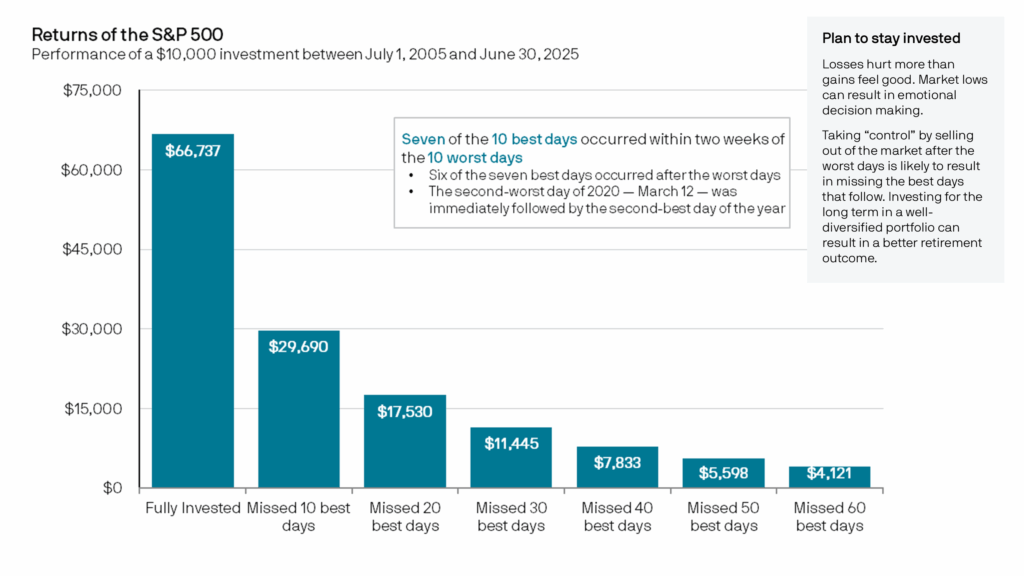
Miss the best 50 days? You’d have 92% less wealth than if you had remained fully invested.
Why There Will Always Be Reasons to Fear
One of the most powerful visuals in investing is a long-term stock market chart showing every crisis and market crash plotted against decades of steady growth. From oil shocks and wars to recessions and pandemics, the S&P 500’s history (1970–2022) shows that the long-term trend rewards patience.
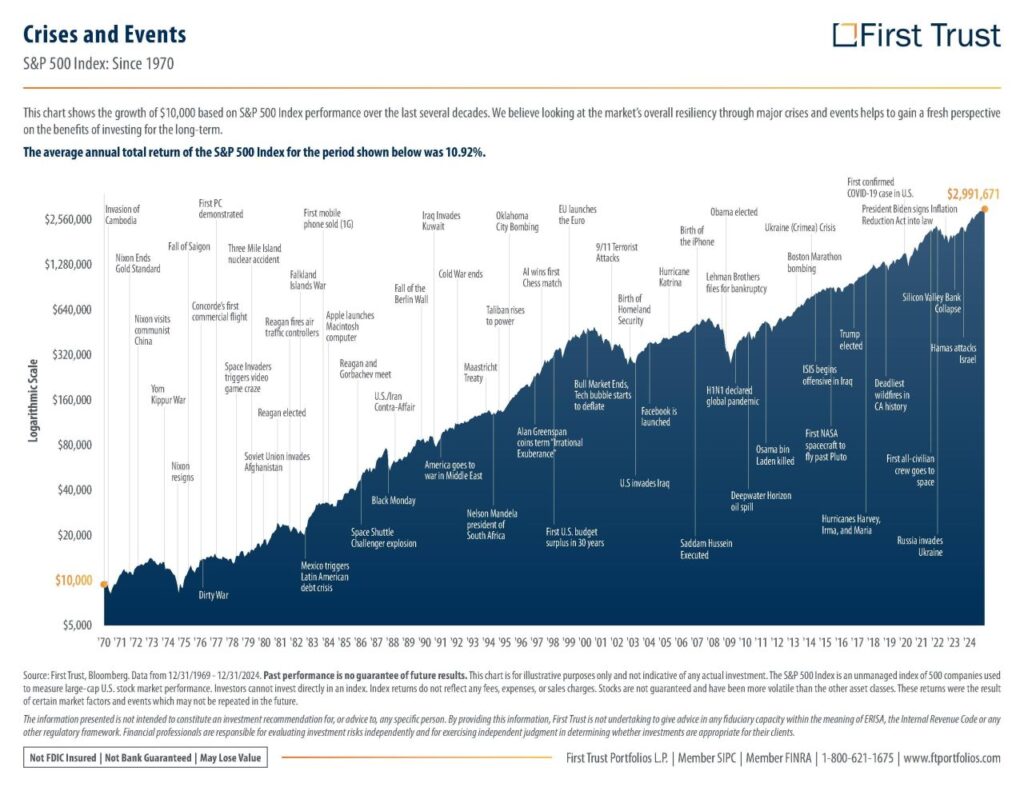
First Trust research going back to 1942 reveals:
- Average bull market: 4.4 years, +153.2% total return
- Average bear market: 11.3 months, –32.1% total return
The same principle holds for the South African market: on the JSE ALSI, staying invested consistently outperforms missing even a handful of strong days. Avoiding short-term losses often means missing the sharp rebounds that follow.
A Balanced Perspective on Risk
Some academics note that “missing the best days” statistics can be exaggerated if they assume impossibly bad timing. That’s fair – but the practical truth remains: predicting both downturns and rebounds is next to impossible.
This doesn’t mean every investor should be 100% in equities. The right asset allocation depends on your goals, risk tolerance, and investment time horizon – which is why working with a qualified financial adviser is invaluable.

Key Lessons for Long-Term Investors
- Stay the course – Remaining invested captures the power of compounding; jumping in and out risks missing the market’s best moments.
- Volatility is the toll, not the enemy – Big up days often sit right next to big down days; miss one, and you often miss the other.
- Prioritise process over prediction – A disciplined investment plan and regular portfolio rebalancing work better than trying to forecast short-term moves.
Final Thought
When it comes to time in the market vs timing the market, the evidence is clear – the patient investor usually wins. Focus on long-term wealth building, stay disciplined through volatility, and remember: the market rewards time and consistency, not perfect predictions.
Sources
- J.P. Morgan Asset Management – Guide to Retirement
- First Trust Advisors LP, Bloomberg. Daily returns from 4/29/1942 – 3/31/2021. Past performance is no guarantee of future results. Data is based on daily returns; using different time periods would produce different results. The S&P 500 Index is an unmanaged index of 500 stocks used to measure large-cap U.S. stock market performance.